Direct-to-Satellite Mobile: The Next Frontier or a Fragile Promise?
Direct-to-satellite mobile promises global coverage, but faces real threats in spectrum, security, and sustainability. Here’s what telcos, regulators, and innovators need to know

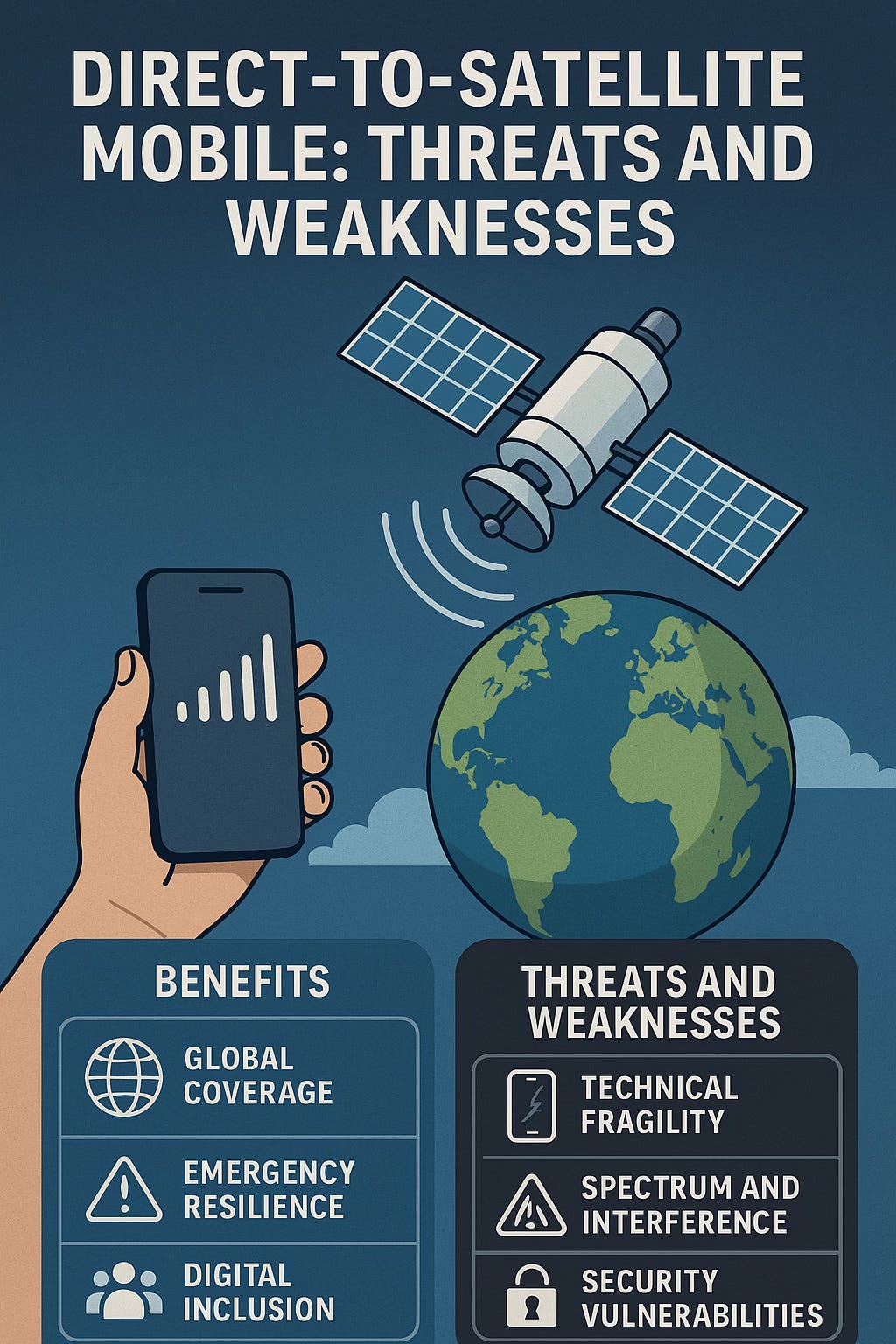
For decades, mobile coverage maps have been full of holes. Vast rural areas, oceans, deserts, mountains — all remain “dead zones.” Now, a new wave of innovation promises to erase those blank spaces: direct-to-satellite (D2S) mobile communications.
The vision is seductive. A single handset, no bulky satellite phone, no special antenna. Just your iPhone or Android device connecting directly to a satellite in low earth orbit (LEO) or, in some cases, geostationary orbit (GEO). Whether you’re on a hiking trail in Alaska, fishing off the coast of Ghana, or trapped in a post-hurricane blackout, the idea is the same: your phone still works.
But behind the headlines and glossy demos lies a more complicated reality. As with all big technology shifts, the opportunities are matched by structural weaknesses and risks that could undermine the promise. Let’s break down what’s happening, who’s driving it, and why caution is just as important as ambition.
The New D2S Landscape
Several players are shaping this fast-evolving ecosystem:
Apple and Globalstar – Apple’s iPhone 14 and later models support Emergency SOS via Globalstar’s constellation, enabling text messaging to emergency services in remote areas. A highly controlled, narrowband use case.
T-Mobile and SpaceX – T-Mobile USA is working with Starlink to offer satellite text coverage in PCS spectrum (1.9 GHz). Early demos look promising, but it’s a long way from mass deployment.
AST SpaceMobile – Pitched as the first company to offer direct 4G/5G broadband from space. They’ve conducted live calls via AT&T, Rakuten, and Vodafone, but the antennas required are massive and power-hungry.
Lynk Global – Focused on messaging, with regulatory approvals in multiple countries. Their approach uses smaller satellites to provide SMS connectivity first.
3GPP NTN standards – The 3GPP Release 17 specifications introduced “Non-Terrestrial Networks (NTN),” laying the foundation for standardized integration of satellites into 5G systems.
Together, these efforts mark a transition from experimental to commercial. By the late 2020s, many expect hybrid networks, blending terrestrial 5G and D2S as standard features in mobile plans.
The Promise
The benefits of direct-to-satellite are compelling:
Global coverage – No matter where you are, connectivity follows.
Emergency resilience – Critical in disaster scenarios when towers fail.
Digital inclusion – Extends connectivity to underserved rural communities.
Enterprise value – Sectors like shipping, aviation, oil and gas, and mining gain cheaper alternatives to traditional satphones.
Military and government utility – Tactical resilience and redundancy for communications.
It’s not hard to see why telcos, governments, and consumers are excited. Yet as we peel back the layers, the threats and weaknesses come into sharp focus.
Weakness 1: Technical Fragility
The dream of holding up your phone to the sky and streaming video directly from space is far from reality. Here’s why:
Link budget constraints – Smartphones have small, low-power antennas, unlike satellite phones with directional gear. Maintaining a stable uplink to a satellite hundreds of kilometers away is difficult.
Coverage gaps – LEO satellites move quickly across the sky. A single satellite covers you for only minutes. Continuous coverage requires large constellations — thousands of satellites in orbit.
Throughput limits – Current implementations are mostly text-only. Voice and broadband demand much more bandwidth and power. AST SpaceMobile’s BlueWalker 3 satellite, with its 64-square-meter antenna, demonstrated a 5G call, but scaling this globally is daunting.
Latency variance – Even with LEO satellites (latency ~20–40 ms one way), handovers between satellites introduce jitter, making consistent performance hard to guarantee.
The result: while D2S works in ideal outdoor conditions, service can degrade sharply in urban canyons, indoors, or under heavy tree cover.
Weakness 2: Spectrum and Interference
Spectrum is the lifeblood of mobile communications — and here lies a regulatory tangle.
Shared spectrum use – D2S often relies on spectrum bands already allocated to terrestrial operators (e.g., PCS, LTE bands). A handset might see both a tower and a satellite on the same frequency. Coordinating who gets priority is complex.
Cross-border interference – Satellites don’t recognize national boundaries. A satellite providing coverage to Mexico may inadvertently cover Texas at the same frequency, triggering regulatory disputes.
Roaming chaos – Today’s roaming agreements are already complicated. Layer satellites on top, and billing, authentication, and QoS become exponentially harder.
Unless regulators and operators collaborate effectively, interference disputes could slow adoption and spark international conflicts over spectrum rights.
Weakness 3: Security Threats from Space
Every new interface creates a new attack surface. Satellites are no exception:
Jamming and spoofing – Relatively inexpensive ground equipment can jam or spoof satellite signals, disrupting services regionally.
Cyberattacks – Satellites are controlled through ground stations. Breaching those systems could allow attackers to manipulate coverage, intercept data, or disable satellites.
Physical vulnerabilities – Space has become militarized. Anti-satellite weapons (ASATs) exist, raising the risk that commercial constellations could become collateral in geopolitical conflicts.
In short, satellites may become attractive targets for state and non-state actors alike.
Weakness 4: Business Model Uncertainty
Who pays for all this? The economics are still unclear.
Bundling vs. premium pricing – Apple has bundled emergency SOS for free (for now). T-Mobile hints at including text coverage in plans. But full service at scale will require sustainable revenue streams.
Consumer expectations – If customers expect 5G-like data rates globally, disappointment is inevitable. Text-only or low-bandwidth services may feel like a let-down.
Operator alignment – Mobile operators see D2S both as an opportunity and a threat. Too much reliance on satellites could commoditize terrestrial networks. Too little involvement, and they risk losing relevance.
History reminds us that roaming promises often start strong and unravel when billing disputes and customer frustration collide.
Weakness 5: Sustainability and Space Debris
The satellites enabling D2S are not infinite resources floating serenely above Earth. They are part of an increasingly congested orbital environment.
Mega-constellations – Starlink alone has over 6,000 satellites in orbit, with plans for tens of thousands. Add AST, Lynk, OneWeb, Amazon Kuiper, and others, and space becomes crowded.
Collision risk – Each satellite increases the chance of orbital collisions, which can create debris clouds threatening other satellites.
Environmental impact – Rockets launching satellites burn fuel, and re-entering satellites release materials into the atmosphere.
A “gold rush” mentality could lead to orbital unsustainability, threatening not just D2S but weather monitoring, GPS, and other critical satellite services.
Weakness 6: Dependence and False Security
Ironically, the more society leans on D2S, the more fragile resilience may become.
Disaster reliance – If D2S becomes the default emergency fallback, what happens if a storm, cyberattack, or conflict disables the constellation?
Consumer assumptions – People may believe “satellite equals always-on,” but weather, equipment, or congestion can still disrupt coverage.
Over-reliance by operators – If operators outsource too much resilience to satellites, investment in terrestrial robustness could decline.
In resilience planning, redundancy is king. Satellites should complement, not replace, strong terrestrial infrastructure.
The Road Ahead
D2S is not a gimmick. It has real, transformative potential. But to succeed, the industry must address its weaknesses head-on:
Technology – More efficient antennas, better power management, and robust satellite handover are essential.
Regulation – International agreements on spectrum use and interference management must be hammered out.
Security – Satellites need end-to-end encryption, hardened ground stations, and constant monitoring.
Business models – Operators must balance inclusion with sustainability. Subsidized emergency services may coexist with premium enterprise offerings.
Sustainability – Coordinated space traffic management is critical to avoid a future of orbital chaos.
Conclusion: Promise with Peril
Direct-to-satellite mobile is one of the most exciting frontiers in connectivity. It could transform access in remote regions, save lives in disasters, and open new enterprise markets.
But it is not a silver bullet. Its weaknesses — from technical fragility and spectrum disputes to security threats and sustainability risks — demand careful attention.
For now, the safest way to think about D2S is not as a replacement for terrestrial 5G, but as a complementary layer in a broader ecosystem. Like all layers of infrastructure, it must be secure, sustainable, and economically viable.
The industry should resist the temptation to over-promise. Otherwise, the very sky that seems limitless today may prove to be tomorrow’s weak link.
📌 What do you think? Will direct-to-satellite mobile deliver on its promise, or will the risks outweigh the rewards? Share your thoughts below.